

Understanding the Historical Jesus
The figure of Jesus of Nazareth stands at the nexus of history and faith, with an extensive body of literature and archaeological evidence contributing to our understanding of his life and the times in which he lived. To comprehend Jesus as a historical figure, one must delve beyond the theological interpretations that dominate the religious texts, focusing instead on the cultural, political, and social contexts of first-century Judea.
Scholars have heavily relied on the Synoptic Gospels—Matthew, Mark, and Luke—alongside the Gospel of John, to piece together a historical narrative. These texts, while rooted in faith, also offer insights into Jesus’s life and teachings. For example, the context of Roman rule in Judea during this period significantly influenced the lives of the Jewish people and subsequently the ministry of Jesus. The tensions arising from Roman occupation are reflected in several passages, providing a clearer understanding of Jesus’s interactions with both Roman authorities and Jewish leaders.
Archaeological discoveries, such as the ruins of first-century synagogues and the remains of ancient towns like Capernaum, bolster the historical figure analysis of Jesus. Such findings can corroborate geographic and social aspects noted in the biblical texts. They set the scene for understanding the milieu in which Jesus preached, including his emphasis on equality and social justice, themes that resonate within the socio-political context of his time.
Furthermore, the argument for a historical Jesus often juxtaposes his life against the myths and theological elements that have evolved from these accounts over centuries. By discussing the historical Jesus, it becomes evident that while religious narratives serve particular theological functions, a distinct figure exists, marked by specific actions and teachings, corroborated by the available historical evidence. This careful separation between the actual historical figure and the mythologized versions is crucial for comprehending Jesus’s influence in both historical and contemporary contexts.
Hinduism: The Oldest Religious Culture
Hinduism, often referred to as Sanatana Dharma, is widely regarded as one of the oldest religious traditions in the world. Its roots can be traced back over 4,000 years, making it not only a spiritual framework but also a rich cultural tapestry that has evolved through various historical epochs. The explanatory breadth of Hinduism is monumental, as it encompasses a vast array of beliefs, practices, and philosophies that inform the lives of millions around the globe.
Core beliefs in Hinduism include the concepts of Dharma (righteousness and duty), Samsara (the cycle of birth, life, death, and rebirth), Karma (the law of cause and effect), and Moksha (liberation from the cycle of Samsara). These principles guide adherents in their daily existence and spiritual pursuits, promoting a life aligned with ethical values and spiritual insights. The religion is profoundly interconnected with numerous rituals and practices, which vary significantly according to regional, cultural, and historical contexts, further enriching its diversity.
Hindu scriptures, including the Vedas, Upanishads, and the epics like the Mahabharata and Ramayana, form the bedrock of its theological and philosophical discourse. These texts not only offer instructions on rituals and codes of conduct but also explore profound metaphysical questions about existence and the nature of the divine. Through these scriptures, the historical significance of Hinduism permeates various aspects, touching on philosophy, ethics, and even science.
Moreover, Hinduism’s influence can be observed across other religious traditions, including Buddhism and Jainism, which share several foundational concepts with it. This interconnectivity emphasizes Hinduism’s role as a predecessor in the broader religious landscape. Its layered traditions and enduring practices have shaped cultural identities and fostered a deep sense of belonging among its followers.
Similarities Between Jesus and Hindu Religious Figures
The lives of Jesus Christ and prominent Hindu figures such as Krishna and Rama reveal notable parallels, which could suggest a deeper, universal spirituality shared across cultures. Both Jesus and Krishna, for instance, are depicted as divinely inspired beings who impart vital teachings to humanity. The moral lessons attributed to Jesus, such as love, compassion, and forgiveness, resonate closely with the teachings of Krishna, where concepts of dharma (righteousness) and karma (action) are pivotal.
In terms of miraculous acts, both Jesus and these Hindu deities are known for performing extraordinary deeds that signify their divine nature. Jesus is credited with healing the sick, raising the dead, and turning water into wine, whereas Krishna is often celebrated for his ability to perform miracles, such as lifting a mountain to protect his devotees and manifesting his divine form. These miraculous events serve to reinforce the notion of their roles as saviors and protectors.
Additionally, the philosophies underpinning their teachings reveal a striking alignment. Jesus emphasized the importance of an internal relationship with God, advocating for personal spirituality over institutionalized religion. Similarly, Krishna’s teachings in the Bhagavad Gita advocate for yoga and self-realization within the individual, bringing forth the idea that true spirituality emerges from within rather than through external rituals. This emphasis on inner enlightenment promotes a cross-cultural dialogue centered on the quest for truth and self-knowledge.
Furthermore, concepts of sacrifice and redemption are central to both traditions. Jesus’ crucifixion represents the ultimate sacrifice for humanity’s sins, while in Hinduism, figures like Rama exhibit sacrifice for the greater good, exemplifying dedication and adherence to dharma. These themes illustrate a cohesive understanding of morality and spirituality, bridging the divide between these two sacred traditions.
The Interconnectedness of Faiths: Analyzing Syncretism
Syncretism, the amalgamation of diverse beliefs and practices, plays a significant role in understanding the evolution of world religions, particularly when examining Christianity and Hinduism. Throughout history, religious traditions have not developed in isolation; rather, they have been influenced and shaped by interactions with one another, leading to a rich tapestry of spiritual expression. For instance, early interactions between Hindu and Christian traditions, especially during the colonial period, led to the adoption of various practices and ideologies, illustrating how faiths can inform and enhance one another.
The influence of Hinduism on Christianity is evident in various aspects, such as the portrayal of Jesus Christ and the incorporation of certain philosophical concepts. The image of Jesus as a spiritual teacher resonates deeply with Hindu notions of divine incarnation or avatara. This concept suggests that divinity can manifest in different forms, depending on the needs of the world, thereby strengthening the perception of Jesus within the Hindu context. Furthermore, writings from early Christian missionaries often reflected a blend of native cultural elements with Christian theology, aimed at making the faith more relatable to indigenous populations.
Similarly, elements of Christianity can be found within Hindu practices, suggesting a bidirectional flow of ideas and beliefs. Understanding these interconnectedness and influences can invest our spiritual cultivation with greater depth. Engaging with the tenets of each religion through an interfaith lens not only enriches personal faith but also fosters dialogue among different religious communities. By recognizing the shared values and teachings across these traditions, individuals are encouraged to promote inclusivity and empathy, which can help mitigate conflicts arising from religious differences.
I was very young and came upon the rumors, or rather, the gossip sounded so real. When I think of that now a days still, I’m confused about whether what I heard is reality or a fiction-minded story. That you, readers, have to decide.
************************
The real story of Jesus and how much in reality it is connected to other religion specifically the high lean towards “Santana Dharam,” which is “Hinduism,” the oldest known religious culture with texts and proofs. Before the start of Christianity, ancient groups of people were defined by the specific empires, civilizations, or tribal cultures they belonged to like the examples below: –
1. The Mesopotamians
- Who they were: The Sumerians, Akkadians, Babylonians, and Assyrians.
- Where: The “Cradle of Civilization” located between the Tigris and Euphrates rivers in modern-day Iraq.
- Historical Impact: They are known for inventing the earliest forms of writing (cuneiform), establishing the first cities (like Ur and Babylon), and creating early legal frameworks like the Code of Hammurabi.
2. Ancient Egyptians
- Who they were: The Kemetians (the ancient people of Egypt).
- Where: The Nile River Valley in Northeastern Africa.
- Historical Impact: Known for constructing the iconic pyramids, developing hieroglyphic writing, and creating a highly advanced, unified society that lasted for thousands of years.
3. The Indus Valley People
- Who they were: The Harappans and the early Vedic peoples.
- Where: The northwestern region of the Indian subcontinent (modern-day Pakistan and northwest India).
- Historical Impact: They built highly advanced, planned urban cities with sophisticated plumbing and drainage systems as early as 3300 BCE.
4. Ancient Chinese Civilizations
- Who they were: The peoples of the Xia, Shang, and Zhou dynasties.
- Where: The Yellow River and Yangtze River valleys in East Asia.
- Historical Impact: They pioneered silk production, bronze casting, and early forms of Chinese writing.
5. The Celts
- Who they were: A diverse collection of tribal societies and Indo-European groups (such as the Gauls, Britons, and Gaels).
- Where: Across Western and Central Europe.
- Historical Impact: Known for their distinct ironwork, art styles, and oral traditions led by a class of priests and judges known as the Druids.
6. Ancient Greeks
- Who they were: City-states like the Athenians, Spartans, and Corinthians.
- Where: The Balkan Peninsula and surrounding Mediterranean islands.
- Historical Impact: They laid the foundational roots for Western philosophy, mathematics, and democratic governance.
To understand how people lived before Christianity, we have to look at a world where religion was not a separate part of life, but life itself. In ancient times, there was no concept of a “secular” world; every natural event, illness, or harvest was directly attributed to the gods.
Taking Ancient Mesopotamia (the Sumerians and Babylonians) as our primary window into this era, here is a look at both their daily lives and the intense belief systems that governed them.
The Ancient Belief System: A World of Many Gods
Ancient peoples practiced polytheism, meaning they worshipped hundreds or thousands of different gods.
- The Gods Were Everywhere: The Mesopotamians believed the gods lived within physical elements. The sun wasn’t just a ball of gas; it was the god Utu. The wind was the god Enlil.
- Humans as Servants: In their creation stories, humans were made out of clay by the gods for one specific reason: to do the physical work that the gods didn’t want to do themselves. Daily life was quite literally viewed as a form of divine service.
- City Patrons: Every single city-state had its own “patron god” who was thought to physically own the city and live in the central temple, known as a Ziggurat.
- The Afterworld was Bleak: Unlike Christian concepts of Heaven, the Mesopotamian afterlife was a dark, dreary “land of no return” where everyone—kings and peasants alike—turned to dust and ate clay. Because of this, they focused entirely on keeping the gods happy to ensure a good life before death
Daily Life: Hard Work, Beer, and Family
Because survival was tied to nature, the daily routine followed a strict, sun-based rhythm.
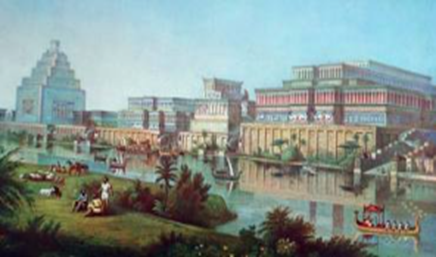
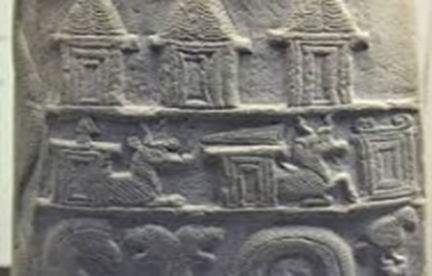
- The Daily Routine: Life started at dawn. Most people were farmers, construction laborers, or weavers. They worked long hours digging irrigation canals, farming barley, or making mud bricks.
- Dietary Staples: They ate two major meals a day. Their diet consisted heavily of unleavened bread, onions, garlic, and stews. Because water was easily contaminated, beer was the primary beverage for everyone—including children—as the fermentation process made it safe to drink.
- Home and Family: Monogamy was the norm for regular citizens. Houses were made of sun-dried mud bricks, featuring flat roofs where families would sleep during scorching summer nights. Wealthier families had wooden beds and chairs, while the poor slept on simple woven straw mats.
- Style and Grooming: Both men and women wore heavy cosmetics. They lined their eyes with early forms of dark mascara to protect against the harsh desert sun and used oil-based perfumes to mask body odor after a long day of labor.
- Evenings and Leisure: When work ended, families gathered to play board games (like the Royal Game of Ur), play instruments like lyres and flutes, sing, and tell oral histories and epic stories.
In Ancient Greece, daily life and religion looked very different from Mesopotamia. The Greeks viewed their gods as deeply flawed, human-like figures, and they placed a massive emphasis on personal achievement, philosophy, and civic duty.
Here is what daily life and belief looked like in Classical Greece.
The Greek Belief System: Human-Like Gods
Greek religion was polytheistic and centered around the twelve Olympian gods.
- Flawed Deities: Unlike modern religious figures, Greek gods were not perfect. They were highly emotional, petty, jealous, and frequently interfered in human affairs.
- No Sacred Texts: There was no “Greek Bible.” Instead, religious guidelines were passed down through epic poems like Homer’s Iliad and Odyssey.
- Animal Sacrifices: To keep the gods happy, Greeks sacrificed animals (like bulls, sheep, or pigs) at outdoor altars. The gods got the smoke and bones, while the people cooked and ate the meat at a community feast.
- The Oracle of Delphi: Before making major life decisions, going to war, or passing laws, leaders and citizens traveled to the Oracle at Delphi. There, a priestess named the Pythia would inhale volcanic gases and speak cryptic prophecies believed to come directly from Apollo.
Daily Life: Philosophy, Agora, and Social Divide
Daily life in Greece depended heavily on whether you lived in a democracy like Athens or a military state like Sparta.
- The Men’s World (The Agora): For free Athenian men, life was highly public. Mornings were spent at the Agora (the central marketplace) to buy goods, debate politics, listen to philosophers like Socrates, and vote on laws.
- The Women’s World (The Gynaeceum): Women in Athens had very few rights and lived mostly segregated lives. They spent their days in the gynaeceum (the women’s quarters of the house), spinning wool, weaving, and managing household slaves.
- The Spartan Exception: In Sparta, life was entirely different. Girls were educated, allowed to own property, and trained in athletics just like boys so they could birth strong soldiers.
- Diet and Wine: The Greek diet relied on the “Mediterranean Triad”: wheat, olive oil, and wine. They drank wine at almost every meal, but always diluted it with water. Drinking undiluted wine was considered a barbaric practice.
- The Symposium: Wealthy Greek men frequently hosted symposiums—late-night drinking parties where they drank, listened to music, recited poetry, and debated intellectual concepts.
Cont…..
All of this started from the period when writings and gossips of virtual realities took shape in reality.
The narrative of Jesus and the assembly of the Christian Bible did not occur instantaneously; rather, they emerged through a multi-stage process spanning centuries, progressing from oral storytelling to handwritten Greek letters and finally to official structural compilation.
The story of Jesus transitioned from an unwritten movement to a standardized text over the course of roughly 350 years.
- c. 4 BCE – 30/33 CE (The Life of Jesus): Jesus of Nazareth lived and operated as a Jewish teacher and prophet in Roman-occupied Judea. He wrote nothing down himself.
- c. 33 – 50 CE (The Oral Era): For about twenty years after Jesus was crucified, his followers spread his stories, parables, and reported resurrection entirely by word of mouth across the Mediterranean region.
- c. 50 – 60 CE (The Letters of Paul): The earliest written documents in the New Testament are not the Gospels, but letters written by the Apostle Paul. Paul wrote these letters (like 1 Thessalonians and Romans) to guide and instruct newly formed churches.
- c. 65 – 95 CE (The Writing of the Gospels): As the original eyewitnesses grew old and passed away, early Christian writers began recording the life of Jesus. This produced the four Gospels:
- · Mark (c. 65–70 CE): The earliest, shortest Gospel.
- · Matthew & Luke (c. 80–90 CE): Expanded narratives incorporating Mark’s framework alongside unique historical traditions.
- · John (c. 90–100 CE): The final, highly theological Gospel.
How the Full Bible Came to Existence
The Christian Bible is divided into two major components, each with its own independent developmental history.
| Bible Section | Origin Timeframe | Language Used | Original Form & Purpose |
| Old Testament | c. 1200 BCE – 200 BCE | Hebrew & Aramaic | The sacred scriptures, law (Torah), and prophets of the Jewish people. |
| New Testament | c. 50 CE – 110 CE | Koine Greek (Common language) | Letters and biographical accounts documenting the life of Jesus and the early Church. |
1. The Adoption of the Old Testament
The earliest Christians were Jewish and automatically utilized the existing Hebrew Scriptures as their holy texts. By the time of Jesus, these books had already been translated into Greek (a version known as the Septuagint), which became widely read by the expanding early Church.
2. The Compilation Process (Canonization)
In the 2nd and 3rd centuries, dozens of competitive Christian texts circulated throughout the region, including various alternative gospels. To maintain structural unity, early church leaders established strict criteria to determine which texts were authoritative:
- Apostolic Origin: The book had to be written by an eyewitness apostle or one of their direct associates.
- Orthodoxy: The text’s teachings had to directly align with established Christian doctrine.
- Universal Use: The text had to be widely read and accepted across all major regional churches.
3. Formal Standardization
The specific 27-book New Testament structure used today was first formally compiled by Bishop Athanasius of Alexandria in 367 CE. This specific list was subsequently ratified and locked into history by western church leaders at the Council of Carthage in 397 CE.
Now starts our hearsay material surfaced from a co-student of mine’s father who used to work in the insides of Vatican Library, stated: –
That there was another Bible called “The Red Bible” which tells many truths which is hidden from normal human kind and from there one of the truths; is the reality of Jesus Christ.
The Maurya Empire was started during the writing of the Old Testament but centuries before the New Testament (the Jesus story) and the completion of the Christian Bible.
It is said that this “Red Bible” originated from the mind of Surya Gupta Moria and with the help of highly learned scholars of the Jewish community, “Kohen” (currently named “Rabbis”). Surya Gupta Moria, who in actuality was one of the twin brothers, the elder one who came first to the Maurya family of India. Chandragupta Maurya was the second of the twins. They were born after the demise or at the demise of their father and were brought up by his uncles and mother in hiding, where both were seen by Chanakya while walking in anger towards Nanda, the king, for insulting him. He studies both and understands that Chandragupta was a warrior by birth, but the eldest one, Surya Gupta, has a nomad’s mind with knowledge and a truth-seeking mind. He teaches both of them accordingly, and when the time came, one of the uncles took Surya Gupta with him on a voyage to Greece on business and to separate the twins to reduce the talk of them in the town and they are not in the sight of their enemies’ eyes and ears. Thus, Surya Gupta Maurya became Surya Gupta Moria in Greek community.
Actually, Christianity was a cult group that was formed with the help of Kohens and Surya from among the Kohen priests who were argumentative, learned, and had a leadership mentality with shrewdness to manipulate and control things for the cult and indirectly to the Kohens. The Jewish group made this cult to grow to an extent where rulers, land, and people come under its spellbound myth, which becomes a reality. They knew that there is a big change coming in the world of power and ruling and they wanted it to be in their control rather than let it free to unleash hell even on them. So, they made a virtual story from the gist of all religious books, mantras, and tantras to make a new religion, God, God’s son, and the sacrifice something different and sacrificial and not done by any form of religion or God of that time. It was a new concept, and it spread like wildfire, and virtual reality became a truth. In actuality, even the current Bible and Jesus all are myths like any other religious stories and characters. But there is a turn in this: Surya, who has traveled and learned many things from different worlds, is now married to a peasant, a true woman of Jewish lineage. He was surprised by her commitment towards family and her husband and home. She pictured her as a true mother of love, compassion, and patience. So, he advised the Kohens to find a nice woman yet almost to the skin color of ordinary Jewish fishermen and farmers. This girl he found from among the Kalash people has a Kushan’s bloodline too. She had a unique problem: her hymen had a opening from the walls of her right vaginal walls. How they found out and why I don’t know, but they knew. He, Surya, brings her to Jewish leaders and says take her to the orphanage and let her stay there.” Find a strong and immune-to-pain Spartan man and milk him. Then take the milked semen of his and pour it in this girl while the girl is tied to left leg and slanting towards right side upside down, while her head and shoulders rested on three soft blankets folded on a table. For one night how she slept like that and who was there with her all is there in the book. The next day she conceived a baby, the Jesus of Nazareth. Surya acted as Joseph and gave a name and support to this story to unfold and make a truth by itself incase of an inquiry by the Romans. Then after a few years, one of the Tales Bearer of the Jesus story, whose name happened to be Joseph was taken out in to the desert near current Muscat, Oman, where an old synagogue stood broken down. His throat was slit cut and made to rest facing east while resting his half-bent body to the old wall. There the sand and wind rose to cover his body and made him dust to dust to end Joseph’s story. Surya goes back to his family. Still in Greece somewhere lies his body and his lineage of Moria family in Greece.
Now the fabricated Jesus who was born was sent to East India, China, and Japan to study their religious books, practices, Mantras and Tantras. He studied many tricks and trades of aghoris, sadhus, and teachers for 16 years. He learned to levitate, the botanical cures, and how “die” means come out of the body and reenter while the body is kept warm and covered. Which he used in death and resurrection and went to India to live in Kashmir and die at the age of 108. He also did learn the tantra of raising mind cocentration power to a point where both eyebrows meet above the nose to make mental Bolts or Jabs. Which yogis of those times used to burn karpur in hand while showing as prsying and giv the ashes as a blessing to people, saying God’s blessings. On the way, his sexual gratification and balancing and calming factor, Mary Magdalene, gave birth to Phillipe Kingstone (“Roach,” meaning “Rock”) at the border of UK and Scotland. She held on to the stone, which had a carving written on it (rough writing, uneven lines) “King” with a sword or something sharp like its the stand stone shaped like an arrow pointing up while stones piled in a form of dome like that of Indian temple tops marking a Tomb or a place or so, which was on a small mount with black stones with white smudges here and there on them, wet from dew or fog and fully grass-matted with here and there purple, white , and yellow small flower sprouts, and here she gave birth to him; thus, the name Kingstone came for him as well as the Rock. He went on to become a king and ruled for many years.
Thus, through Christ the cult Christianity became a big religion. While Surya was away, the Rabbis made a contradictory story of the death of Jesus, showing Judas kissing to show who Jesus was since he looked almost the same as his disciples, who were fishermen and commoners. If that would have been emphasized, then Jesus and his so-called God as father would have been the god of slaves, era-changing, and worshipped by all God. The aftermath of that incident covered the small factor so well that later everyone forgot him as a god of slaves. He was shown as a white man with light olive-green eyes so clear to the unseen depth in them and auburn shoulder-length hair. By which the Jews supported the Christian denomination, which started as a cult dominated in religion with the money and support of royals and the rich. But the church held the control and made Kings, and everyone listen to their whims. So, a story that started was made real to change the history and future of the world.
Another thing mentioned was the Nano technology usage in the myths of the two main Hindu religious epics. The story of God’s skin color transforming to very tall with many heads and weapons and it vanishing. The weapons, which form at the thought if the beholder. Dead people again shatter and join together to live again. 1000 or 10000 years of life span without aging. All that is well explained in the movie Transcendence (2014), a Johnny Depp movie. So, technologies were used by highly intelligent people who visited us those times. Now they don’t because the people who visited may have guessed that the modern civilization will quickly catch up their ideas and reach them. Thus, killing God and such ideas. So they buried the knowledge of travel this far from their upcoming generations, so they lost the way to reach us now.
Even in the “Red Bible,” it is said that if all the people stop worshipping and glorifying and stop going to religious places, then God dies, like people die because God only lives in the mind and fear inside people. Then religious leaders also will become penniless. It is true people help people when in need or accident. No religious places where we put offerings do that. The people who wrote and spread all this is very futuristically visioned people. There are many other stories like this that are truths and practical. Even though there are many historical facts that are hidden from us, they are there. Even I couldn’t fully explain in a better way about the fake god, God’s son, and why they are not hearing you all when you cry and pray to them. Hell is when you suffer; heaven is when you are free of all worries and enjoy your life. There are no gods, devils, or angels. Please don’t waste time on these hypocritical things. Does anyone call God because he/she loves him? “No,” only people ask him to do something or protect them or don’t take away their comforts; that means we all are scared of God, not in love or respect of him. Ya! It is true God should be like a genie who listens to our commands and does good for us like a slave, not to rule, test, and make us forcefully obey him. If he does that, that means he is insecure like a human being.